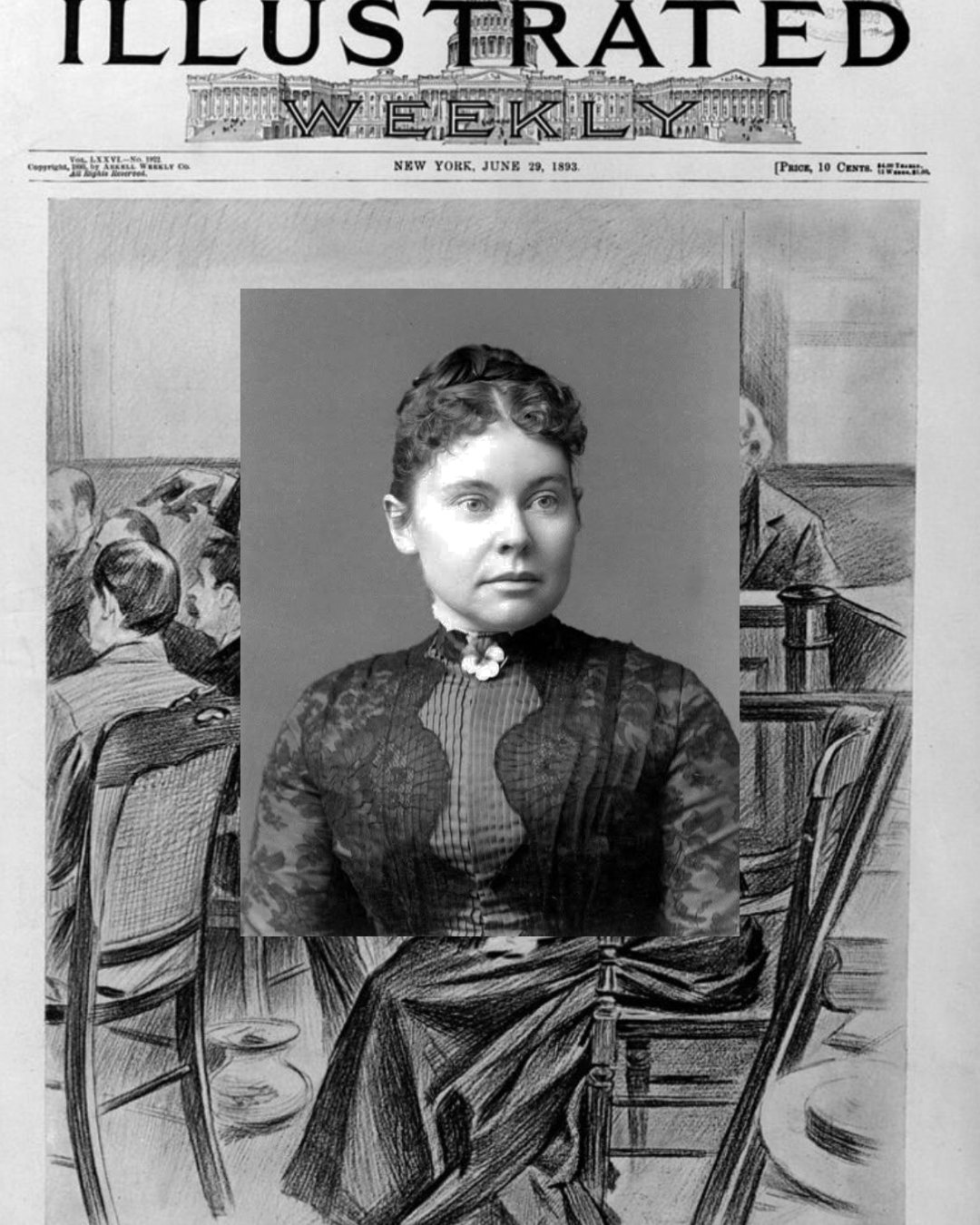
Depending on where you grew up, you may already know the Lizzie Borden story because of its famously dark nursery rhyme. Forty whacks, then forty-one; a sullen spinster, a hatchet, a humid August morning in Massachusetts, 1892. The playground had reached its verdict long before a jury acquitted her in 1893, and it has been reciting the rhyme ever since. To the public eye, to this day, her performance in court fools no one.
Monster: The Lizzie Borden Story, the fourth season of Ian Brennan and Ryan Murphy's true-crime anthology and the first to put a woman at its centre, has little interest in that version, or, frankly, in most of the documented one. Ella Beatty's Lizzie is younger, prettier and far more mysterious than the 32-year-old Sunday-school teacher who stood trial. Charlie Hunnam and Rebecca Hall play parents who were, in life, a couple of decades older than their actors. And one double homicide has been stretched across eight hours, with room left over for a botched oyster poisoning, a great deal of slow-motion blood, and two other notorious female killers.
Critics have not been gentle. At the time of writing, the season sits at 39% on Rotten Tomatoes. TIME's Judy Berman argued it uses Lizzie as a conduit for "just about every plague on womankind," and Consequence said it "wields its themes like an axe to the head." And yet I keep returning to the question the show cannot stop asking, even when it asks it clumsily: what does a woman do when every door out of her life has been locked from the outside? And how does the world perceive her reaction?
Brennan, who wrote all eight episodes, answers by building his season around three women who kill. Lizzie is the main event. The 16th-century Hungarian countess Elizabeth Báthory arrives through a book that the Bordens' maid, Bridget "Maggie" Sullivan (Vicky Krieps), reads aloud to her mistress. And Aileen Wuornos, the Florida sex worker who killed seven men between 1989 and 1990 and was executed in 2002, turns up almost halfway through in the form of Sarah Paulson, on a pilgrimage to the old Borden house, now a bed and breakfast. TIME read the trio as a "simplistic kinship between all female killers." I read it as something else: a kinship not of killers, but of circumstances.
Start with the Borden house, which the series renders as a beautifully upholstered prison. Andrew Borden is a drunk who offers his daughters no warmth and less money. Throughout the series we also glimpse his unsettling fascination with blood and violence, as he describes an almost intimate relationship with his axes and the thrill they give him when in use.
His wife, Abby, torments everyone beneath her, and at one point, in a fit of rage, kills Lizzie's pet doves with an axe. Then, in the second episode, Maggie, by now Lizzie's lover, insinuates that Andrew has been raping her and that she is pregnant. From that moment the house stops being merely miserable and becomes dangerous. Two women with no money, no vote, no rights and no one to tell begin, quite methodically, to plan their way out.
Then there is Báthory, the killer Lizzie discovers through a French book. At first, she looks like the exception to the trio's circumstances. The legend of the "Blood Countess," who supposedly tortured and killed servant girls in her castle and bathed in their blood, is a story about power with no ceiling. But the series gives her a wound, too. As a girl barely into her teens, she is raped three times in a single night by a peasant man and falls pregnant. When her daughter is born, she is not even given time to name her: the maids drown the baby, stuff her into a sack and throw her away while Elizabeth watches, sobbing. (Historians disagree about whether the real Báthory had a child as a teenager; the rape and the drowning are the show's invention.) Her later murders read as revenge as much as sadism, and it is telling whom she chooses: young women of the same servant class as the maids who took her child, and the children of her rapist. The violence done to her travels downward, to women even less protected than she was.
Wuornos needs the least embellishment of all. Her grandfather beat her with a belt and, she said, sexually abused her. At 14 she was pregnant after being raped by one of his friends, and was made to give the baby up. Her first victim, Richard Mallory, was a man she said had raped and beaten her, and who, it later emerged, had a previous conviction for attempted rape in Maryland. Paulson plays her as a woman who has been fighting men since childhood and has long since stopped expecting anyone to take her side.
What does a woman do when every door out of her life has been locked from the outside?
Images: public domain, free for commercial use. Composite: WO/
Look at how each story ends and the pattern becomes clearer. Lizzie, who learns to cry and faint on cue in the courtroom, is acquitted and buys a mansion with her inheritance. Wuornos, coarse and unrepentant, is convicted and executed. Báthory is walled up in her own castle. TIME's critic surveyed those outcomes and asked what, exactly, the show was trying to say. My answer: that none of the systems judging these women ever asked what had been done to them first, or bothered to listen to their cries for help. In the show's telling, Lizzie walks free because the men in the jury box can't picture a lady with an axe, not because anyone listened. Wuornos dies because she couldn't perform the part.
The Gilded Age setting makes the trap unusually easy to see. In 1892 a woman in Massachusetts couldn't vote or sit on a jury, and an unmarried daughter depended on her father for every dollar. Andrew Borden was rich; his daughters lived as though he weren't. Whoever controlled his money controlled their lives, so when Lizzie and Maggie talk about the murders as a route to freedom, the show is pointing at something real. For a woman of Lizzie's class, inheritance was one of only two doors out of her father's house. Marriage was the other, and she had already scared off a suitor.
And the law offered no third door. Who, exactly, would Maggie report her sexually abusive employer to? The police, the judges and the juries were all men, and an Irish servant's word would not have outweighed a banker's. The series never says outright that justice would fail these women. It doesn't need to; every man with authority on screen confirms it.
"All your books are written by men," Maggie tells Lizzie in the premiere. Read between the lines and the message is not really about books, but about Lizzie's whole world: the stories she grows up on, the laws, the courts, the rules for how a woman should behave. Men wrote all of it. It is the closest thing the season has to a thesis statement. Lizzie, and women in general, live inside a system they had no hand in writing. When it ends, unsubtly, with Lizzie and Maggie living openly together and joining the fight for the vote, the point is clear enough: real change only came once women won a say in the rules. Before that, the series suggests, the only power within these women's reach was the violent kind. That says far more about the world they lived in than about the women themselves.
These situations don't just belong to Victorian gothic. Statistics show the same patterns still occurring today.
In 2021 the Centre for Women's Justice published Women Who Kill, a four-year study of women who kill in England and Wales. In 77% of the 92 cases it examined, there was evidence that the woman had experienced violence or abuse from the person who died. Only 7% were acquitted. Of the 20 women the researchers interviewed, eight had already reported the abuse to police. And the danger runs overwhelmingly the other way: in the year to March 2019, 38% of female homicide victims in England and Wales were killed by a partner or ex-partner, against 4% of male victims.
Sally Challen killed her husband, Richard, with a hammer in 2010 and was convicted of murder the following year. In 2019 the Court of Appeal quashed that conviction after hearing new evidence about her mental state and the decades of coercive control that preceded the killing. She pleaded guilty to manslaughter on grounds of diminished responsibility and walked free that June. In Wisconsin, Chrystul Kizer was 17 when she shot Randall Volar in 2018. Prosecutors later said there was no doubt he had sexually assaulted her and other girls. In August 2024, she was sentenced to 11 years in prison after pleading guilty to second-degree reckless homicide.
Neither woman is Lizzie Borden, and neither case makes killing right. What they share with Monster's three women is this pattern: the abuse came first, the exits were few, and the institutions meant to protect them either weren't listening or arrived too late. Psychologists describe the body's response to threat as fight, flight or freeze. According to Simply Psychology, freezing can leave a person feeling "numb or flat, like you're on autopilot," or make them dissociate entirely. When flight requires money, a home and someone who believes you, some women are left with only two options: shut down and keep enduring the trauma, or fight.
TIME's critic suggests the show's central argument, that repression breeds rage, is about as revelatory as the news that water is wet. In a living room, perhaps. In a courtroom, the figures suggest it still needs saying. That is the strange achievement of this messy, frequently exploitative season. It fails as history and often as drama, but somewhere beneath the hatchets, the clichés and the over-sexualisation, it lands on a point.
When a woman kills, we ask what was wrong with her. Jealousy, greed, madness. We rarely ask what was wrong around her. In 2016, Shana Grice, 19, reported Michael Lane to Sussex Police five times in six months. Officers fined her for wasting police time. That August, he murdered her. Stories like hers feel familiar because they keep repeating: the reports, the dismissals, and an ending decided by whoever strikes first.
A woman who kills to stay alive in the last, frantic seconds of that story is not a murderer by nature. She is someone who should never have been left there in the first place. Protection schemes like Clare's Law, which WO/ has investigated, still depend too much on luck. Before we ask why she picked up the weapon, we might ask who she called first, and why nobody came.
If you are affected by domestic abuse in the UK, the National Domestic Abuse Helpline is free and open 24 hours a day on 0808 2000 247.
Sources
- Monster: The Lizzie Borden Story, Wikipedia
- Judy Berman, review for TIME, 18 September 2026
- Liz Shannon Miller, review for Consequence, September 2026
- Lizzie Borden, Wikipedia
- Aileen Wuornos, Wikipedia
- Centre for Women's Justice, Women Who Kill: summary report, 2021
- Women's Aid, "Women who kill: how the state criminalises women we might otherwise be burying"
- Killing of Richard Challen, Wikipedia
- Garden Court Chambers, "Sally Challen walks free", June 2019
- Court TV, "Chrystul Kizer sentenced in killing of man who trafficked her", August 2024
- Olivia Guy-Evans, "Fight, Flight, Freeze, or Fawn: How We Respond to Threats", Simply Psychology, updated June 2025
- Local 10 News, "Police fine teen for reporting ex-boyfriend, then he killed her", April 2019