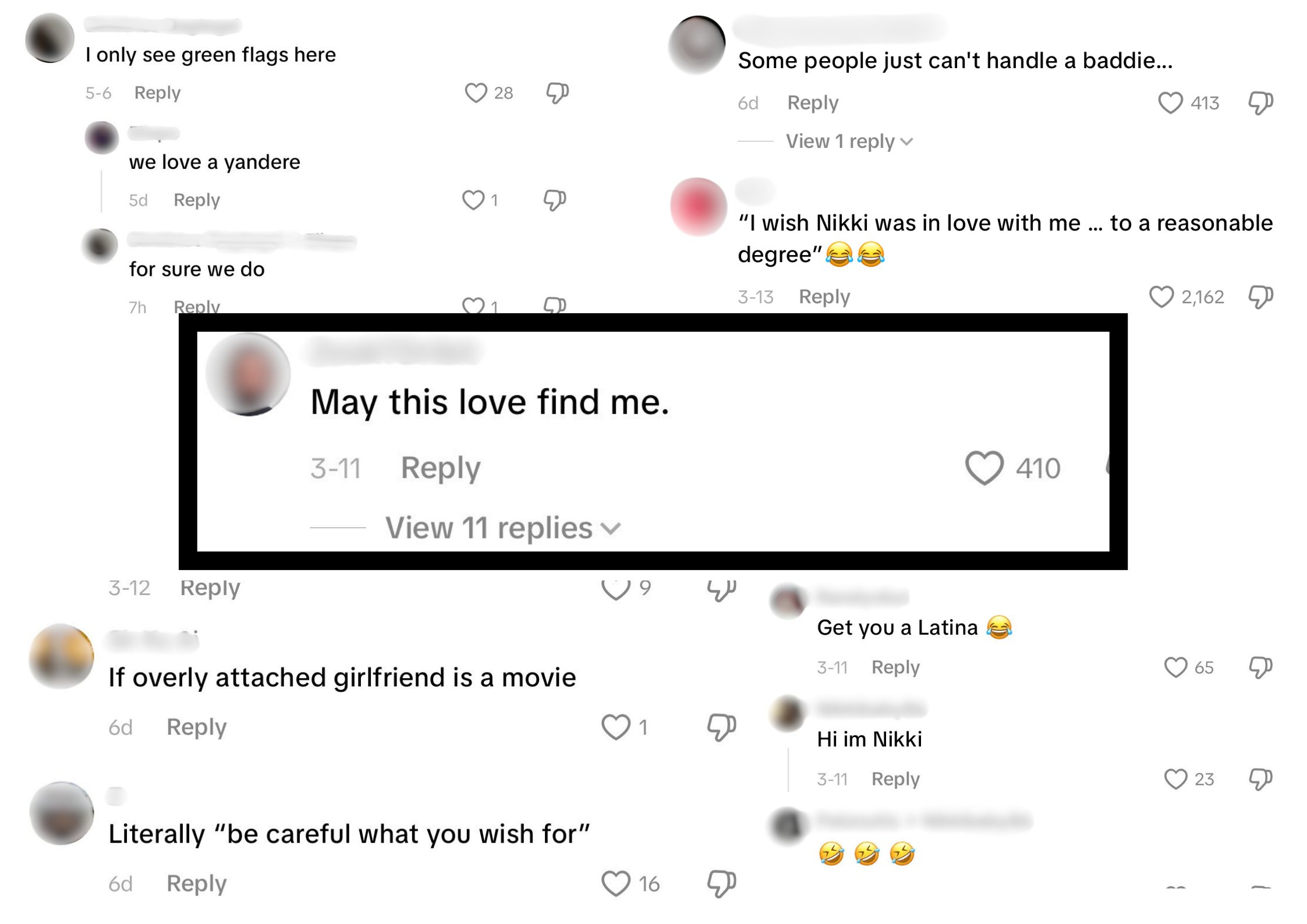
Within days of Obsession hitting cinemas on May 15th, TikTok did what TikTok does: it turned a horror film into a conversation. Clips circulated, reactions poured in, and somewhere in the middle of it all, something truly unsettling started appearing in the comment sections. People watched a woman be stripped of her autonomy, trapped inside her own body against her will, used and ignored while she screamed for help, and they responded with some version of the same thought: this is the kind of love I want. This or nothing. Or, more alarmingly still, some women were boasting or joking about their husbands comparing them to Nikki’s possessed character, suggesting that “this feels like home.”
A woman is conscious. She is aware. She breaks through her own possession at a party, grabs a broken bottle, and stabs her own face repeatedly while screaming “it’s not me,” a desperate, last-resort attempt to make someone, anyone, understand that the person controlling her body is not her. And some spectators watched that and saw romance, related to it, and joked at the idea that this is the type of “crazy” women men have to deal with. Disregarding the fact, that if it weren’t for Bear’s actions, Nikki would never have been in this state to begin with.
That is not a misreading of the film. That is a confession that some people either don’t realise that some relationships bring out the worse in them, or that they are bringing out the worse in others.
For anyone who hasn’t seen it yet, Obsession follows Bear, a twenty-something music store employee with an unreciprocated crush on his childhood friend Nikki. Too scared to simply tell her how he feels, Bear makes a wish on a supernatural toy called a One Wish Willow. He wishes for Nikki to “love him more than anyone in the world.” The wish is granted. Immediately, and horribly.
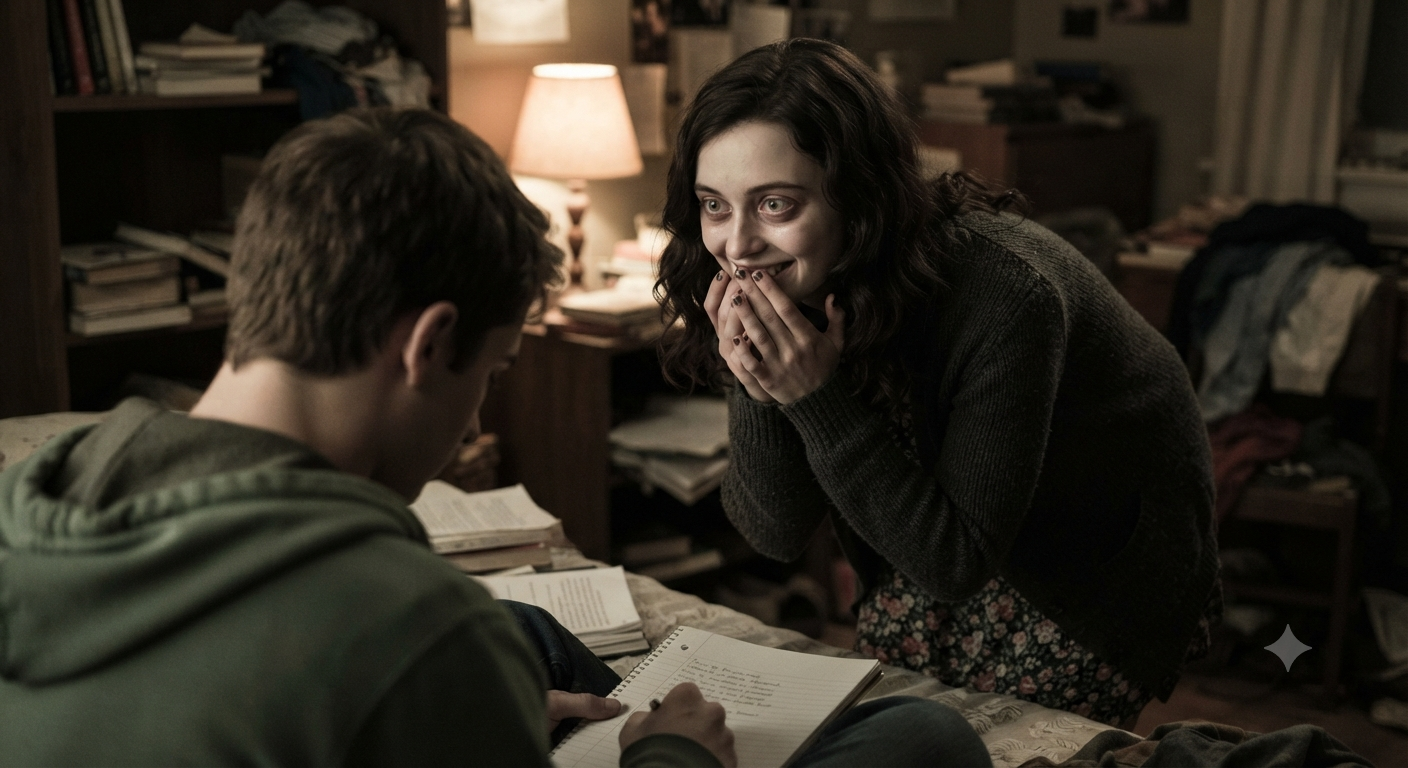
It is remarkable how many people have failed to grasp the selfishness Bear displays throughout the film, as he proclaims himself as a typical nice guy. Even with a single wish at his disposal, he could have bestowed it upon himself, wishing for the confidence to confess his feelings, for instance. Instead, his wish disregards the possibility that Nikki might simply not be into him, because she has the right not to have those same feelings for him without it being offensive or problematic to him. The movie uses this moment perfectly to highlight how dangerous it can be as a woman in a society where men fear rejection, even worse, some simply don’t accept it.
His wish denied her the right to decide her own feelings. His choice of words is telling, too. To be loved more than anyone in the world. It is fair to say he carries insecurities, which surface as a fear of rejection, a fear of not being enough. He doesn’t want to be loved in an organic way, in a healthy or balanced way. He wants her to love him the most. He wants to sit at the top of the food chain, untouchable in Nikki’s eyes. Much like how some men behave today inside the red-pill, blue-pill worldview. According to the Encyclopedia Britannica and articles released by the Canadian government in understanding the manosphere and its keywords, being in the blue pill state suggests adopting a mindset where men blindly accept mainstream narratives and social norms. In a way, portraying blue pilled men as less-than. Naive, weak, compared to the red-pill men. Red-pill men adopt the belief that society is systemically biased against men in favour of women, and they engage in misogynistic views.
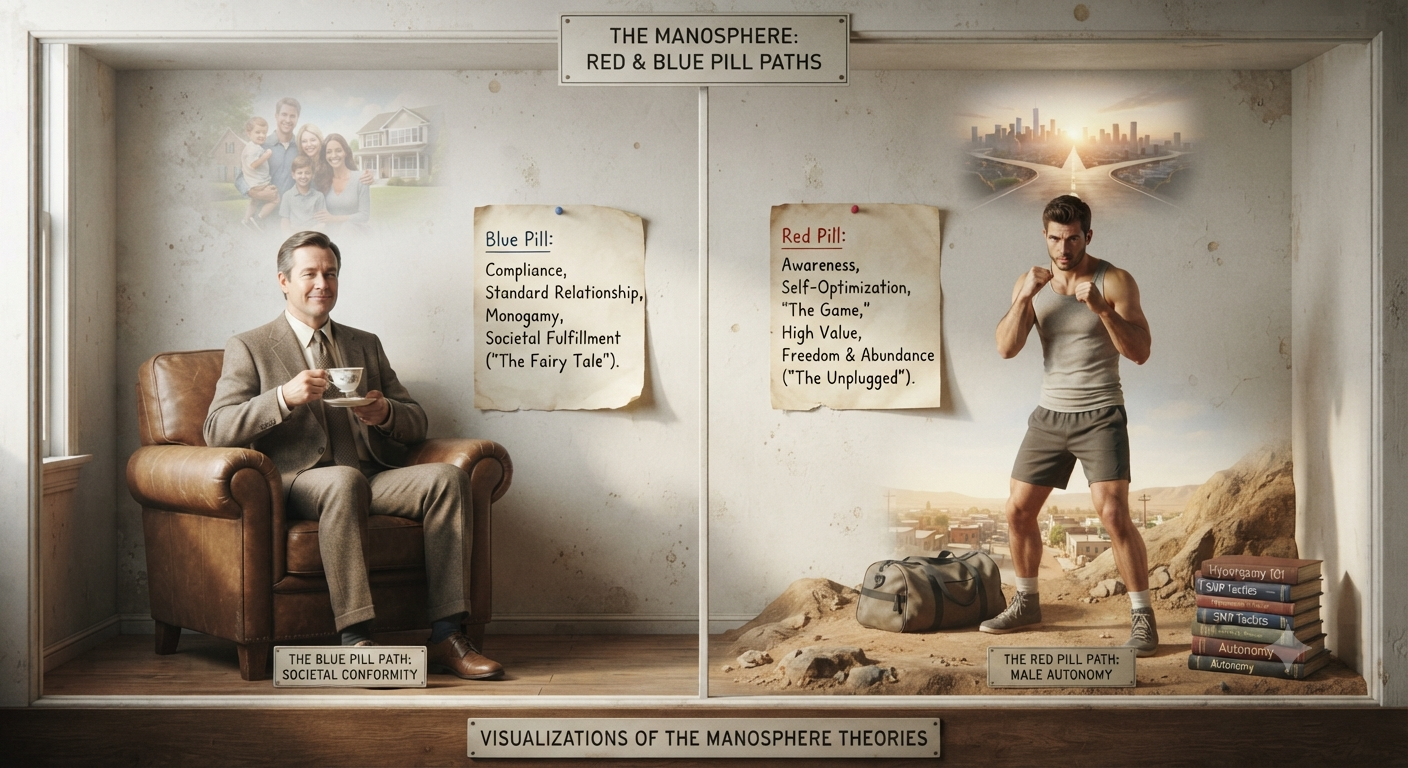
Men like Bear, who portray themselves as innocent, naive men, actually act in ways that red-pill men would. Humiliating a woman, forcefully stripping away her rights, and on top of that, complaining about her reactions to it, as if she should be grateful. In one of the scenes, Nikki’s possessed self is asleep, and the real Nikki attempts to get through to her former friend, Bear, letting him know that she is being possessed, and begging him to kill her, to end her misery, in response Bear utters “What’s so bad about dating me” before walking away to meet with another woman.
A lot of the TikToks coming from men revolve around their girlfriends or exes having BPD, and how it reminds them of Nikki post-possession. Interestingly enough, the comment sections beneath those videos are split. Some women claim to have shown similar behaviour patterns. Some men joke that you don’t need to be with someone who has BPD to get this kind of treatment, you just need to “date a Latina.” Others chime in to agree that their partners with mental health disorders act this way. It is so normalised it barely registers anymore. But it should be far from normal. Some of these men sound like Bear himself: attempting to gain sympathy from strangers, trying to look like the victim, trying to look like a nice guy. In reality, this casual mockery of women behaving in distress is nothing more than internalised misogyny, and they are fuelling it. Not all of them, but in many situations people stay with partners who are struggling and treat them horribly because, on some level, they enjoy the internal suffering of that person. Some men find it enjoyable that a woman would put her comfort, her safety, her voice aside to cater to him. To be fully absorbed by him. And this is evident in a lot of online comments regarding the movie. It is almost as if, internally, some people are still attached to the idea of having someone serve their every need, even when, in reality, it strips that someone of their own dignity every day, and feeds their emotional instability.
He knows the woman he is living with is not the real Nikki. He knows the real Nikki is in there, suffering. He knows because she told him, in her own words, in her own voice, in the quiet moments when the entity sleeps. He knows because he has tried to change the wish. Not cancel it, at first, but tweak it. Adjust it to be more to his liking. Again, making a decision for his own convenience rather than giving Nikki her body and soul back. Yet, supposedly, he loved her. And this is a friend he had known his whole life, a friend whose trust he gained.
By calling the company number on the One Wish Willow box, he was even able to hear the real Nikki screaming in agony. And still, he hesitates. Still, he delays. Still, when she begs him to end it, to free her from this, he refuses. Not because he can’t. Because he doesn’t want to lose what the wish gave him. Her. Her in a world where she is all his. A world where she will abide by his every desire, where he owns her. He chose his needs and wants, over her survival, over her right to consent. He chose to keep the part of her that he can control. Some viewers might assume the One Wish Willow is the scary, eerie part of this story. That is simply not true. It was Bear’s unnatural wish, his desire to dictate someone else’s feelings and decisions, that was the real antagonist.
If you strip away the supernatural element, you are left with something very familiar. A man who could not accept rejection. A man who found a way to have a woman on his terms, without her consent. A man who, even when confronted with direct evidence of her suffering, prioritised his own feelings. The horror is not the monster. The horror is how recognizable he is.
Cinema has been making this recognisable for a very long time.
Think about how many films have handed us obsession dressed up as devotion. Edward Cullen in Twilight, a man who watches a teenage girl sleep without her knowledge, controls who she sees, and is framed as the romantic ideal. We did not call it stalking. We called it passion. Love. Protection. Noah in The Notebook, who hangs off a Ferris wheel and refuses to come down until a girl agrees to go on a date with him. We did not call it coercion, or emotional manipulation. We called it persistence. We framed it as old-fashioned romance, where men put in more “effort” to prove their love. Danny Zuko in Grease, who spends an entire film not changing a single thing about himself, while Sandy dismantles her entire identity to become someone he might want. We called it a happy ending.
And then there is the subtler version. The films that turn women’s suffering into spectacle. The camera that lingers on female pain in a way it never lingers on male pain, like excessive sexual assault scenes. The female character who exists to be threatened, rescued, or destroyed so that the male character can feel something and become something. The “crazy woman,” Gone Girl, Fatal Attraction, Single White Female, where female anger, female hurt, and female desperation are coded as unhinged or crazy, while the male behaviour that provoked it is quietly excused or forgotten. Much of this plays out in real life too, where a man hurts, manipulates, gaslights, and the fingers get pointed at the woman who reacts.
We have been watching this for decades. We have been absorbing it. And then we act surprised when men sit in front of a film about a woman being possessed without her consent all for the pleasure of one man, and think: yes, that. I want that.
To its credit, Obsession does not ask you to find it romantic. It is unflinching about what Nikki’s experience actually is. It does not look away from her suffering, or tidy it into something digestible.
The film even makes the SA element impossible to ignore if you are paying attention. The real Nikki is communicating clearly and repeatedly that she does not consent. Every intimate moment Bear has with her body after that is not a grey area. It is not complicated. There is a woman inside that body screaming no, and the film knows it, even if some of its audience chose not to.
And that is exactly the problem. The film did the work. Some of the audience didn’t.
Because here is what those comments actually tell us. They tell us that the fantasy of a woman who cannot say no, who is physically, supernaturally, completely devoted to one man regardless of her own will, is not a horror concept to everyone watching. To some, it is “goals.” And that is not a failure of imagination or a misunderstanding of genre. That is the direct result of a culture that has spent a century telling men that a woman’s resistance is an obstacle to be overcome, that love means possession, and that the right amount of persistence, or magic, or force, will eventually make her yours.
The scariest thing about this film was never the monster. It was always the men who watched a woman trapped, suffering, begging to die, and wished they had a One Wish Willow of their own.