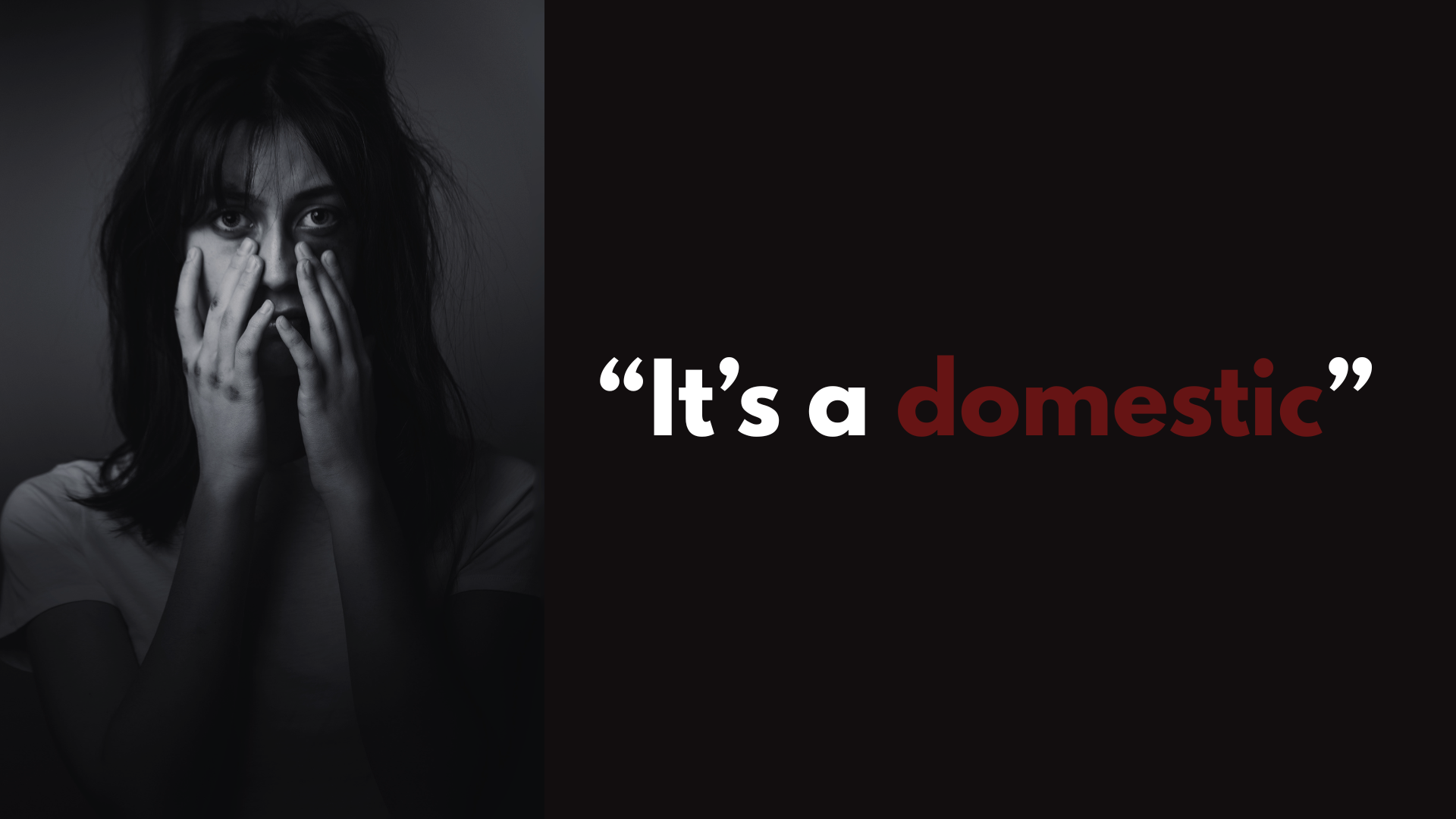
In 2023, inspectors reviewing case files at Dyfed-Powys Police found that a woman who had been threatened with a blowtorch had her case wrongly filed as “standard risk.” So had reports involving non-fatal strangulation and rape. The force accepted the findings in full. The language used inside that filing system, low risk, standard, a domestic, wasn't incidental to what happened next. It was the first decision made about how seriously the case would be taken.
The real question isn't whether individual officers were careless. It's whether the word doing the filing, "domestic," was ever built to carry the weight of what it's being asked to describe.
A word built to keep the door closed
"Domestic" didn't start out as police shorthand for a crime. It started as a description of where something happened, not what happened. A dispute between neighbours over a fence is a dispute. An assault between two strangers on the street is an assault. But violence between people who share a home has, for decades, been sorted first by location and relationship, and only afterward by the act itself.
Research from Scottish Women's Aid, tracing police and social work responses through the late twentieth century, found that officers were trained toward what researchers call non-interference in cases involving partners, built on the assumption that what happened between a husband and wife was a private matter, not a public one. That assumption outlived the training manuals that taught it. It settled into the language instead, into a single word small enough to file an assault under without ever calling it one.
What the inspectors actually found
In 2014, Her Majesty's Inspectorate of Constabulary reviewed how all 43 police forces in England and Wales were responding to domestic abuse. The resulting report, Everyone's Business, found that the police response to domestic abuse was "not good enough and must be improved," even though it accounted for roughly one in ten recorded offences at the time. Only eight of the 43 forces inspected were rated as responding well.
The law disagrees with the word
On paper, at least, the law has moved well past "a domestic." The Domestic Abuse Act 2021 gave England and Wales their first statutory definition of domestic abuse. It covers physical and sexual abuse, threatening behaviour, controlling or coercive behaviour, economic abuse, and psychological or emotional abuse, whether that's a single incident or a sustained pattern. Section 68 of the same Act created a specific offence of non-fatal strangulation, closing a gap that had let some of the most lethal forms of abuse get charged, if charged at all, as common assault.
The legal architecture no longer minimises. The everyday word still does. A police log that reads "domestic incident" and a police log that reads "attempted strangulation" can describe the exact same event. Only one of those descriptions tells you what actually happened.
The most recent figures from the Office for National Statistics show what "a domestic" is actually standing in for. Police recorded 816,493 domestic abuse-related crimes in England and Wales in the year ending March 2025, accounting for 15.4% of all offences recorded by police that year. The Crime Survey for England and Wales, which captures abuse that never reaches a police station, estimated that 3.8 million people experienced domestic abuse that same year, 2.2 million of them women.
Roughly one in six recorded crimes in the country now falls under this heading. That's a volume of harm large enough to shape national crime statistics, and it's still being introduced to the public, case by case, as "a domestic."
What newsroom guidance is now asking for
Journalists have been told, formally and repeatedly, to stop reaching for the euphemism. Level Up, working with victims' families, criminologists and domestic abuse specialists, published the UK's first media guidelines for reporting domestic abuse deaths, challenging headlines that frame femicide as a "crime of passion" rather than what the guidelines describe as the predictable outcome of sustained coercive control. They ask outlets to name the crime specifically, and to place responsibility on the person who caused the harm rather than treating the death as some kind of unexplained event.
Women's Aid has run parallel training with national and regional newsrooms for the same reason. Being specific isn't about style. It's about whether readers actually understand what happened. The press regulator IPSO now hosts its own guidance on reporting domestic abuse, developed with the same organisations. None of this exists because "domestic" is hard to define. It exists because, left undefined, the word has spent decades failing to do justice to the survivors, the victims, or the gravity of what actually happened to them.